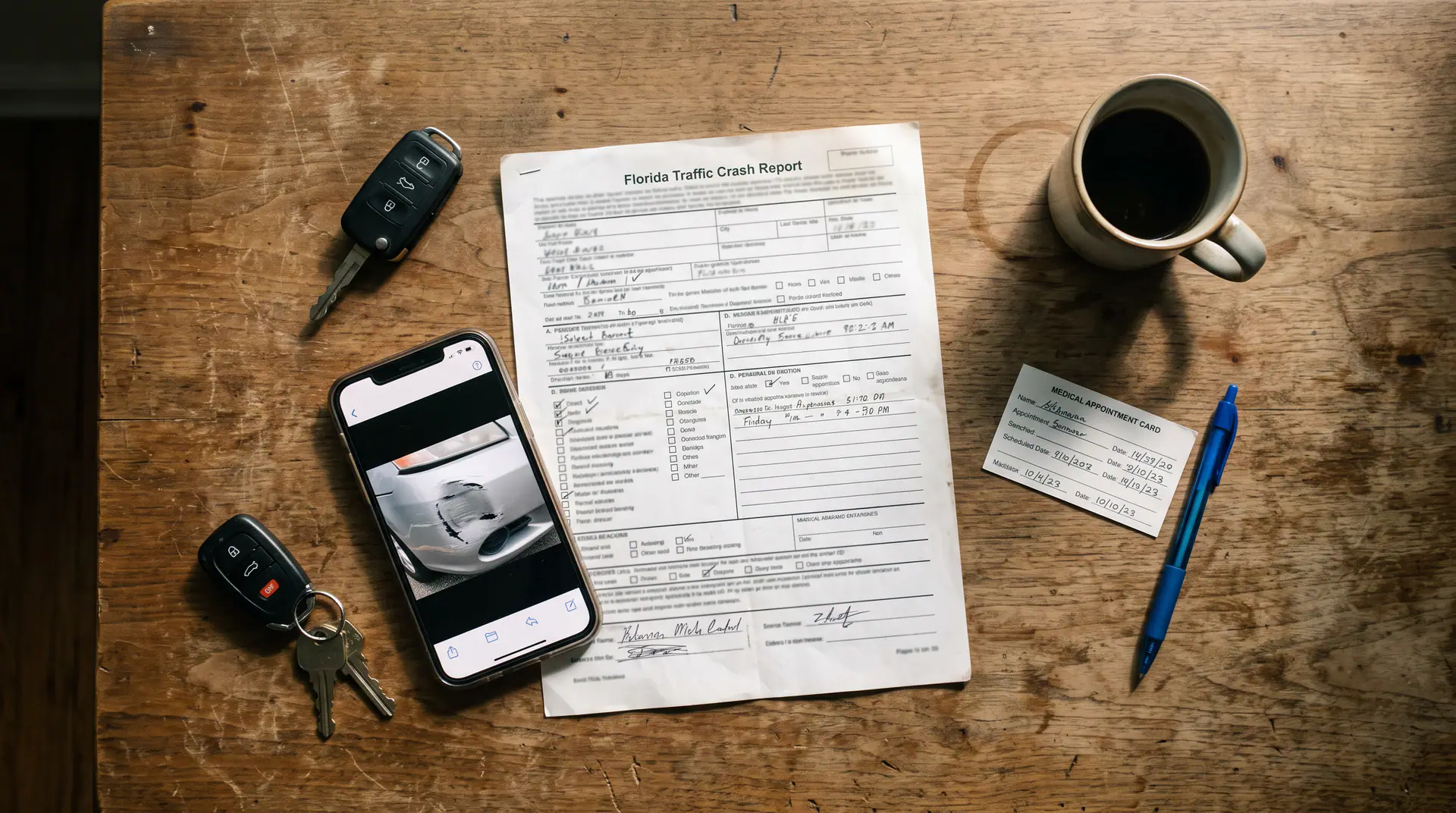
Your Step-by-Step Checklist After a Florida Accident
The minutes and days after an accident are confusing, and the choices you make can affect both your recovery and your claim. This checklist walks you through what to do, what to avoid and which Florida deadlines start running right away.
The checklist
Get to safety and call 911
If you can, move out of traffic and turn on your hazard lights. Call 911 if anyone is hurt, and let paramedics check you even if you feel more shaken than injured.
Report the crash to law enforcement
Florida law (section 316.065) requires reporting a crash that involves injury, death, or apparent property damage of $500 or more. Ask the officer for the report number and the agency's name.
Exchange information, but do not argue fault
Get names, phone numbers, driver's license numbers, plate numbers and insurance details. Be polite and stick to the facts. Avoid apologizing or guessing about what happened.
Photograph everything
Take photos and video of every vehicle, the road, skid marks, traffic signals, the weather and your visible injuries. Note any businesses or homes nearby that might have cameras.
Find witnesses
Get names and phone numbers from anyone who saw the crash. An independent witness can settle a fault dispute months later.
Get medical care within 14 days
Under Florida's PIP law (section 627.736), you must get initial medical treatment within 14 days of the crash to use your PIP benefits, and benefits can be limited to $2,500 unless a qualified provider determines you had an emergency medical condition.
Notify your own insurer, briefly
Report the accident as your policy requires, but keep it to the basic facts until you understand your injuries.
Do not give a recorded statement or sign anything
The other driver's insurer may ask for a recorded statement, a medical authorization or a release. Talk with a lawyer first.
Stay off social media
Do not post about the accident, your injuries or your activities. Insurers look, and a single photo can be taken out of context.
Keep records and call a lawyer early
Save medical bills, receipts, pay stubs and the name of every provider you see. Then call us before key evidence is lost.
Why the First Few Days Matter
Insurance companies start building their file on your claim almost immediately. Adjusters call quickly, evidence starts disappearing, and Florida's PIP rules put a short clock on medical care. You do not need to do everything perfectly. You just need to avoid a few common mistakes and protect what you can.
Mike Hancock spent the start of his career defending insurance companies before founding our firm in 1996. Many of the steps below come from knowing exactly which mistakes adjusters look for.
Seeing a Doctor When You Feel Fine
Adrenaline masks pain. Neck, back and head injuries often show up hours or days after a crash. A prompt medical visit protects your health first, and it also creates a record linking your injuries to the accident.
Gaps in treatment are one of the first things an adjuster looks for. If you wait weeks to see a doctor, or stop going to appointments, the insurer may argue that something else caused your pain. Follow your doctor's plan and keep your appointments.
What to Say, and Not Say, to Insurers
You will likely hear from two insurers: your own and the at-fault driver's. Your own policy may require you to cooperate, so report the crash. The other driver's insurer is a different matter. Its adjuster's job is to pay as little as the facts allow.
A friendly call asking how you are feeling can end up in your file as "claimant said she felt fine." Releases and broad medical authorizations can give the insurer access to years of unrelated records, or end your claim entirely. Before you give a recorded statement or sign anything, call us.
Social Media and Your Claim
Assume anything you post will be seen by the defense. A picture from a family cookout or a comment that you are "doing okay" can be used to argue your injuries are not serious. Set your accounts to private, avoid posting about the accident or your recovery, and ask friends and family not to tag you.
Evidence Disappears Fast
Some of the most valuable evidence in an injury case does not last. Many businesses record over their surveillance video within days or weeks. Vehicles get repaired or sold for salvage, and with them go crash data and physical damage. Witnesses move and memories fade. After a truck crash, electronic logging device data, black-box data and driver logs need to be preserved quickly.
When we are hired early, we can send preservation requests, collect video and photographs, and secure evidence before it is gone.
If You Were Hurt Somewhere Other Than the Road
Not every injury happens in a car. If you fall in a store or restaurant, report it to the manager, ask for an incident report, and photograph whatever caused the fall, your shoes and the area around it. Under section 768.0755, a person hurt by a "transitory foreign substance" in a business must prove the business had actual or constructive knowledge of the dangerous condition, so early evidence matters. The same instincts apply to boat accidents, dog bites and golf cart crashes: get care, document what happened, and get advice.
Florida Deadlines to Keep in Mind
- 14 days to get initial medical treatment if you want to use PIP benefits after a car crash.
- Two years to file most negligence lawsuits arising on or after March 24, 2023 (section 95.11, Florida Statutes). Wrongful death claims generally must be filed within two years of the date of death.
- Earlier notice requirements for claims against government entities, which must be met before a lawsuit can be filed.
Exceptions exist, and some deadlines are shorter, so do not rely on a general rule for your own case. Call us and we will confirm yours.
How We Help in the First Days
Our first conversation covers the practical problems that pile up after a crash: getting your car repaired, your right to a rental car, how Florida's no-fault law affects your medical bills and lost wages, and whether your injuries may meet Florida's threshold for pain and suffering damages. Then we take over the calls with adjusters so you can focus on getting better. See how the legal process works for what comes next.
Talk With Us Before You Talk With the Insurer
If you were hurt in an accident, call (813) 915-1110 or contact us online for a free consultation. We answer the phones 24/7, and there is no fee unless we recover money for you.
Frequently Asked Questions
Do I need to see a doctor if I feel fine after a crash?
Yes. Many injuries take hours or days to show up, and Florida requires initial medical treatment within 14 days of a car crash to use your PIP benefits. Prompt care also creates a record linking your injuries to the accident.
Do I have to report a minor fender-bender?
Florida law (section 316.065) requires reporting a crash involving injury, death, or apparent property damage of $500 or more. Repair costs add up quickly, so when in doubt, call law enforcement and get a report.
Should I give the other driver's insurance company a recorded statement?
Not before talking with a lawyer. You generally are not required to give the at-fault driver's insurer a recorded statement, and what you say can be used to dispute fault or minimize your injuries.
What if the driver who hit me has no insurance?
Check your own policy for uninsured/underinsured motorist (UM/UIM) coverage. It is optional in Florida, but when you have it, it can pay for losses the at-fault driver cannot. We can review your policy during a free consultation.
How long do I have to file an injury claim in Florida?
For most negligence claims arising on or after March 24, 2023, Florida generally allows two years to file a lawsuit. Exceptions exist and some deadlines are shorter, especially for claims against government entities, so call promptly.